The short answer
Most buyers do not need the highest-grade steel available. They need the grade that matches the wire you run and the cycle rate you run it at.
- Carbon steel and low-alloy wire, normal cycle rates → H9. Balanced wear resistance and toughness, the economical working choice.
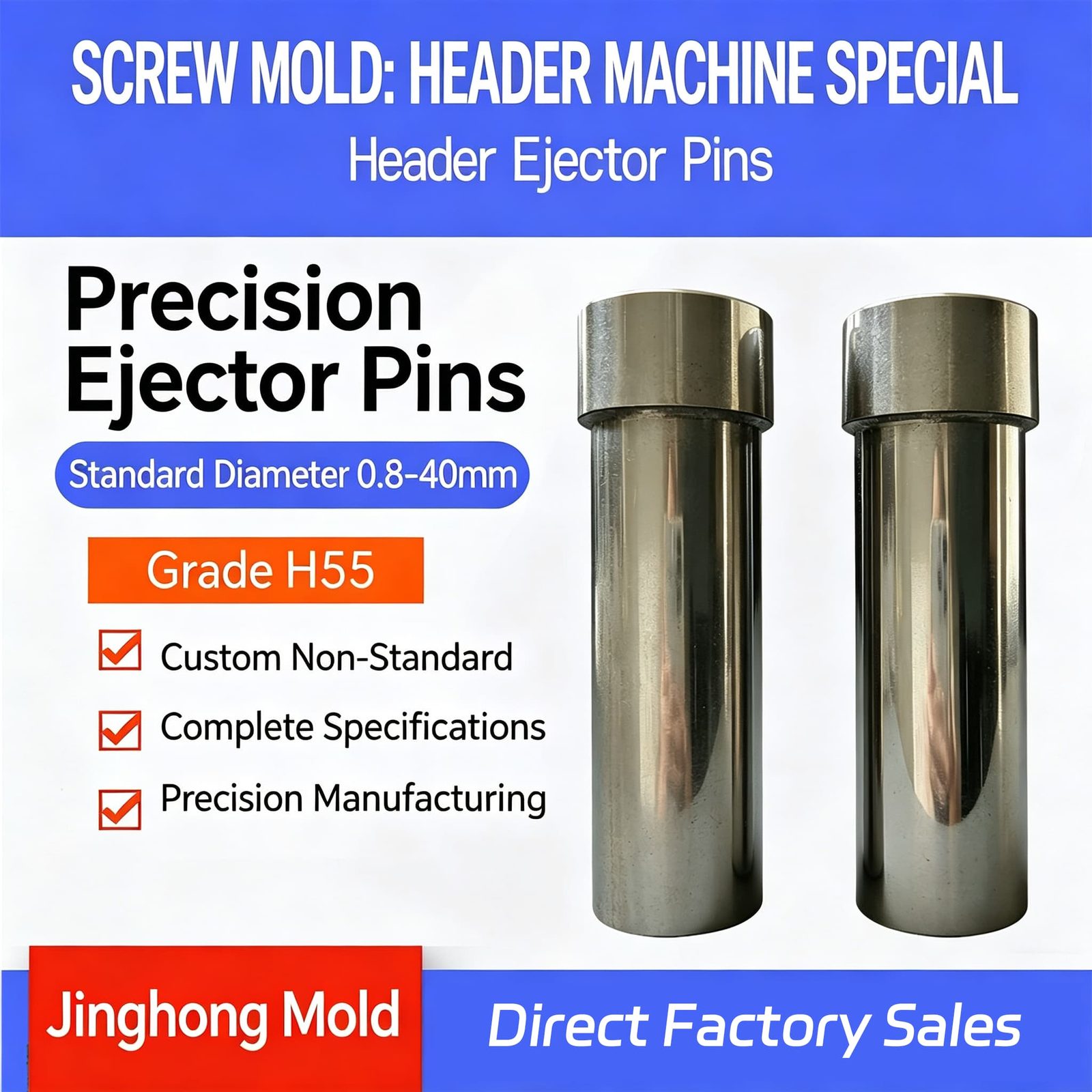
- General fastener work where you want more hardness than H9 without cobalt cost → H55+. A domestic high-speed steel grade that sits between the two.
- Stainless steel, high-speed multi-station headers, long continuous campaigns, or difficult-to-eject material → M42. Cobalt HSS with the highest attainable hardness and the best hot hardness of the three.
All three are supplied in 0.8 mm – 40 mm diameter, 40 mm – 250 mm length, at ±0.01 mm tolerance, vacuum heat treated, with material certificates.
Why the ejector pin grade matters
After every punch cycle the ejector pin (also called the KO pin) has to push the formed blank out of the die cavity — cleanly, repeatably, thousands of times an hour. It is not a structural part. It is a wear part, and it is the wear part that decides whether your die set keeps its cycle count or comes off early.
Three failure modes drive most replacement decisions:
- Abrasion — the working face wears into the blank, and head dimensions drift out of tolerance before the die insert is anywhere near worn out.
- Galling and pick-up — material sticks to the pin face, then tears the blank surface on the next stroke.
- Softening at temperature — at high cycle rates the pin face runs hot. A grade that loses hardness at working temperature wears fast even if it measured HRC correctly on the bench.
The grade you should buy is decided by which of those three is actually killing your current pins. Material selection is not a ranking — H9 is not "worse" than M42, it is differently specified.
The three grades compared
| H9 | H55+ | M42 | |
|---|---|---|---|
| Material type | High-speed steel | Domestic high-speed steel | Cobalt high-speed steel (8% Co) |
| Hardness | HRC 60–63 | HRC 61–64 | HRC 64–66 |
| Standard diameter | 0.8 mm – 40 mm | 0.8 mm – 40 mm | 0.8 mm – 40 mm |
| Length range | 40–250 mm | 40–250 mm | 40–250 mm |
| Tolerance | ±0.01 mm | ±0.01 mm | ±0.01 mm |
| Core strength | Wear resistance + toughness | Higher hardness than H9, good toughness | Highest hardness, best hot hardness, best abrasion resistance |
| Typical duty | Carbon steel, low-alloy wire, general fastener and nut forming | General fastener work, elevated cycle rates, cost-sensitive programs | Stainless steel wire, high-speed multi-station headers, long continuous runs |
| Cost position | Lowest of the three | Middle — the value pick | Highest |
The practical read of this table: hardness is the variable you are actually buying. H9 → H55+ is a one-step hardness increase (HRC 60–63 → 61–64). H55+ → M42 is a larger jump (HRC 61–64 → 64–66) and brings cobalt with it.
When to specify H9
H9 is the default answer for a reason — its hardness range is wide enough to handle ordinary carbon steel and low-alloy wire, and its toughness is high enough that the pin does not chip at the shoulder when it takes an impact at the start of the stroke.
Specify H9 when:
- You are running carbon steel or low-alloy wire
- Cycle rates are moderate — single-station or conventional two-blow / three-blow headers
- Your current pins are wearing gradually and evenly, and you are replacing them on a normal schedule
- You want the lowest-cost grade that still holds ±0.01 mm
If your pins are chipping rather than wearing, that is a toughness and geometry signal, not automatically a hardness signal — check the shoulder radius and the ejection stroke before stepping up a grade.
When to specify H55+
H55+ is the middle grade, and middle grades are useful because most problems are not at the extremes. If H9 is soft enough to wear faster than you want, but M42 is more than the program needs, H55+ closes the gap.
Specify H55+ when:
- You run general fastener work across mixed materials rather than one dedicated stainless line
- Cycle rates are higher than conventional, and pins are softening at the face
- You are running long enough campaigns that tooling cost per part matters more than unit price
- You want a step up from H9 without the cobalt cost of M42
The honest framing: H55+ is a domestic grade, so it is the sensible choice when the duty is general and the budget is real. It is not a substitute for M42 on stainless or on genuinely high-heat work.
When to specify M42
M42 is an 8% cobalt high-speed steel. Cobalt is what holds hardness at temperature — and temperature is the variable that decides whether a pin keeps working at high cycle rate.
Specify M42 when:
- You are running stainless steel wire — 304, 410, 416, 430 and similar grades
- You run high-speed multi-station cold headers with continuous, long campaigns
- Your pins gauge, pick up material, or lose dimensional consistency on the working face
- Downtime per pin change is expensive enough that pin life, not unit price, is the deciding factor
Stainless work-hardens fast and grips the cavity harder, which raises extrusion load on every stroke. That combination — abrasive load plus heat — is exactly what cobalt HSS is for. If your pins are failing within weeks on stainless, moving from H9 to M42 is usually the change that pays for itself in avoided downtime.
How to choose without over-specifying
A short decision path that works for most buyers:
- Stainless steel wire? → M42. Nothing else in this range will hold up the same way.
- Carbon or low-alloy wire, and pins wear evenly on schedule? → H9. It is the correct answer; do not spend up a grade for no reason.
- Mixed materials, higher cycle rates, pins softening at the face? → H55+.
- Still unsure? → Send us the failed pin or the drawing. A photo of a pin that failed tells us more than a description of the problem, and we will tell you which grade fits the actual failure — including when the answer is that you do not need to step up a grade at all.
Related reading
If you already know you need one specific grade rather than a comparison, these go deeper:
- H9 Grade Precision Ejector Pins for Screw Header Machines — the toughness and wear balance for carbon steel and low-alloy wire
- M42 Cobalt HSS Ejector Pins for Stainless Steel Screw Production — why cobalt HSS earns its cost on stainless
Specifications across all three grades
| Item | Specification |
|---|---|
| Grades | H9 / H55+ / M42 |
| Material | High-speed steel (H55+ domestic grade; M42 cobalt HSS) |
| Hardness | HRC 60–63 / 61–64 / 64–66 respectively |
| Diameter | 0.8 mm – 40 mm |
| Overall length | 40 mm – 250 mm |
| Tolerance | ±0.01 mm |
| Heat treatment | Vacuum heat treated, parameters set per grade and application |
| Non-standard sizes | Made to print — send drawing, sample or failed part |
| Surface | Precision ground and polished |
Units: we work in metric as standard and can quote in inch gauge sizes and ANSI thread designations to match your drawings. If your tooling is specified in inches, tell us the gauge and the thread series and we will cross-reference.
We also supply matching first punch / second punch sets, die inserts and cold heading dies in the same material grades, so a full die set can be specified on one consistent material logic rather than mixed guesses across suppliers.
Common questions
Is higher hardness always better for an ejector pin? No. Hardness improves wear resistance, but very high hardness can reduce toughness. If your failure mode is chipping at the shoulder rather than wearing on the face, a harder grade may make it worse. Match the grade to the failure.
What is the difference between H9 and H55+ in practice? About one step of hardness (HRC 60–63 vs 61–64) and a different price position. For general fastener duty with elevated cycle rates, H55+ is the step up from H9; for stainless or high-heat duty, go to M42 instead.
Can I order a diameter outside 0.8–40 mm? Standard range is 0.8 mm – 40 mm. Outside that range we work made to print — send a drawing, a sample, or a failed pin.
What tolerance can you hold? ±0.01 mm across all three grades. If your drawing calls for tighter on a critical feature, send it with the print and we will confirm feasibility before quoting.
Do you supply material certificates? Yes. High-speed and powder steels are sourced through verified channels with mill certificates and batch records retained.
How long does delivery take? Samples 3–7 days, batch orders 7–20 days.
Why source from JingHong Pins
Our factory has been making precision fastener tooling since 2000 — 26 years, in one of China's densest fastener tooling clusters. We do cold heading dies, punches and ejector pins, and only fastener tooling.
- In-house CNC turning, multi-axis machining, precision grinding, wire EDM
- Controlled atmosphere and vacuum heat treatment — vacuum quenching, cryogenic treatment and tempering, parameters set per material and application
- Profile projectors, hardness testers, height gauges and micrometers for full inspection from incoming to outgoing
- 6,000+ ㎡ workshop, 100,000+ pcs annual capacity, ±0.002 mm highest precision
- Factory-direct — OEM / ODM, made to your drawing or sample, no trading markup
- English communication from quote to delivery, replies within 24 hours on weekdays
Send us your pin drawing — or the pin that failed
If you are choosing between grades, the fastest route is to stop describing the problem and send us the part:
- A drawing or sample → we quote the grade it specifies
- A photo or the worn pin itself → we tell you which grade fits the actual failure mode
- A failed diameter and cycle rate → we tell you what to move up, and whether you need to move up at all
Email: Cliff@JingHongPins.Com WhatsApp / Phone: +86 189 7481 9719 Web: https://www.jinghongpins.com Address: Room 101, No. 72 Sanxing Road, Songmushan, Dalang Town, Dongguan, Guangdong 523770, China